Chaos
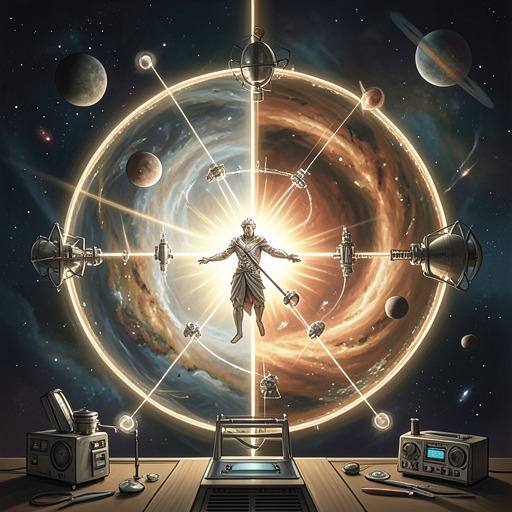
Paradise LostChaos is the primordial abyss beyond the settled regions of Heaven, Hell, and Earth, a place where dimensions, elements, direction, and stability lose their ordinary meaning. It is not merely empty space but a violent pre-creative environment, governed by unstable forces and presided over by Chaos and Ancient Night. The realm gives physical form to disorder while also serving as the dangerous threshold through which Satan travels toward the newly created world and through which later traffic between Hell and Earth becomes possible.
Nature and Cosmic Position
Chaos appears beyond the Gates of Hell as a dark, limitless ocean without shore, measurable dimension, or dependable relation to time and place. Its immensity is expressed through the collapse of ordinary categories: length, breadth, height, time, and location are all said to be lost within it. The abyss is therefore both a location and an assault on the very language used to describe location. It is the “Womb of nature and perhaps her Grave,” a pregnant but unfinished medium in which the materials of possible worlds remain confused rather than formed.
Its substance is not one element but an unstable mixture of all elements in their unresolved causes. Hot, cold, moist, and dry contend for mastery, each surrounded by innumerable atoms and forces that gather into opposing factions. Light and heavy matter, sharp and smooth substances, and swift and slow particles swarm behind competing winds. The result is a realm whose physical disorder is also political: temporary dominance belongs to whichever faction can prevail, while Chaos, acting as umpire, intensifies rather than settles the conflict, and Chance governs beside him.
Rulers and the Law of Disorder
When Satan reaches the heart of the abyss, he finds the throne of Chaos and the dark pavilion of Ancient Night spread across the waste. Orcus, Ades, Demogorgon, Rumor, Chance, Tumult, Confusion, and Discord are gathered around them, giving the region a court-like structure without transforming it into a stable government. Their presence personifies the competing pressures that make Chaos resistant to order. Even its sovereignty is paradoxical: Chaos rules by allowing conflict to continue, and his decisions further embroil the struggle on which his temporary authority depends.
Chaos describes the reach of his threatened dominion as already diminished by successive intrusions. Hell lies beneath and across his realm; Heaven and Earth have recently appeared as another world suspended in a golden chain toward the region from which the rebel legions fell. The image turns cosmology into a history of encroachment. Established creation occupies space that once belonged to primordial disorder, while the abyss remains the unstable frontier at the edges of divine construction.
Satan’s Passage Through the Abyss
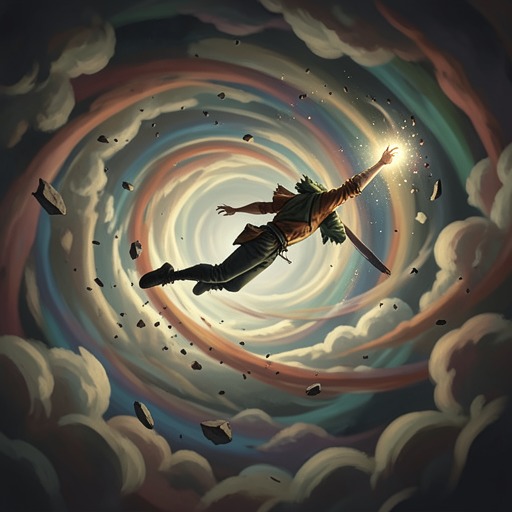
Satan enters Chaos after leaving Hell and pauses at its brink because the passage before him is not a narrow channel but an immeasurable expanse. He spreads his sail-like wings and rises through smoke, only to encounter a vast void in which his wings fail and he drops ten thousand fathoms. A fiery cloud then hurls him upward again; after that force is quenched in a boggy Syrtis, he must proceed by a shifting combination of walking, flying, swimming, wading, creeping, and steering. The journey makes Chaos an ordeal of unstable movement in which no single mode of travel remains reliable.
The region also tests Satan’s audacity rather than simply blocking it. He follows a tumult of confused voices toward the throne of Chaos, undaunted by whatever spirit or power may inhabit the deepest abyss. Before Chaos and Ancient Night, he presents himself not as a spy but as a traveler compelled by circumstance, seeking the nearest route toward light and Heaven. He then converts his private purpose into a political bargain: if he can reach the created region and drive out the power that has taken it, he promises to restore it to Ancient Night’s original darkness and dominion. Revenge is thus framed as an alliance with primordial disorder.
Chaos recognizes Satan as the great leading angel who recently made war against Heaven’s King and was overthrown. He recalls the immense rebel host fleeing through the deep while victorious heavenly forces pursued them. Rather than oppose Satan, he directs him toward the region where Heaven and Earth lie nearest, calling the resulting havoc and ruin his own gain. Satan immediately resumes his journey, rising like a pyramid of fire and forcing his way through battling elements. The passage is compared to perilous voyages through crushing straits and whirlpools, emphasizing that his advance is achieved through labor and danger rather than effortless supernatural command.
Creation and the Receding Abyss
Chaos is not permanently abolished by Creation, but it is bounded. The Son of God rides into the dark expanse with the divine Word and Spirit, and his command ends the discord of the waves. He then uses golden compasses to mark the circumference of the universe, establishing a measurable world within the previously immeasurable depth. Earth is founded, air is separated, and light emerges from the darkness; each act converts undifferentiated potential into ordered distinction.
The Firmament further confines Chaos by dividing the waters above from those below. The world is built upon calm surrounding waters, while the “loud misrule” of Chaos is pushed away so that extreme elements will not remain dangerously contiguous. This does not make the abyss cease to exist. Instead, divine power gives it a boundary and prevents its disorder from distempering the created frame. Chaos consequently becomes the outside against which the world’s structure defines itself.
Bridges, Boundaries, and Later Consequences
After Satan’s successful passage, Sin and Death construct a monumental bridge along his track from Hell across the abyss to the created world. They gather and harden the floating and slimy matter of Chaos, petrifying it with Death’s mace, binding it with Gorgonian rigor and asphaltic slime, and fastening the immense structure with adamantine pins and chains. The bridge joins Hell to the wall of the world and creates a broad, smooth route for spirits to pass between the infernal realm and Earth.
This transformation changes Chaos from an almost impassable frontier into a corridor of consequence. Sin and Death’s bridge makes intercourse and transmigration possible, allowing rebellious spirits to travel toward mortals in order to tempt or punish them, except where God and good angels provide special protection. A realm that once resisted passage through violent elemental confusion is therefore partially colonized by the consequences of rebellion. The bridge does not signify the triumph of Chaos alone; it also reveals how sin converts disorder into an enduring infrastructure.
When Adam and Eve are expelled from the Garden of Eden, Chaos remains part of the larger spatial system through which the poem connects judgment, exile, and future history. The flaming sword guards the eastern gate, while the created world opens before the fallen pair. Their departure does not place them directly inside Chaos, but the world they enter is now linked to Hell by the bridge made across the abyss. Chaos thus stands behind the human condition as the cosmic interval through which infernal influence has gained access to earthly life.
Narrative and Thematic Significance
Chaos gives the poem a visible geography of opposition between rebellion and order. Heaven establishes boundaries, measure, and hierarchy; Hell is a fixed habitation of punishment; Earth is a newly formed world; Chaos lies between and around these regions as the unstable remainder that creation must contain. Its spatial disorder mirrors the moral disorder of Satan’s project, yet it also exposes the limits of Satan’s power: he can exploit the abyss, but he cannot master the forces within it.
The realm’s scale produces a cosmic form of dread. Satan’s enormous body, his plunging fall, the warring elements, the throne surrounded by personified confusion, and the seemingly endless distance all place individual will before forces that exceed comprehension. Yet the abyss is not outside providence. Satan’s permission to move through it and the later appearance of light at its boundary show that even the deepest disorder remains within a larger divine design. Chaos can delay, endanger, and provide instruments for evil, but it cannot prevent the formation of the world or determine the ultimate meaning of its history.